

North Star Metrics are crucial to guide companies and teams toward their mission. As a sailor (more on that later) I’m familiar with the North Star as a navigational beacon - find the North Star and you can find your way home. Similarly, by keeping the North Star metric as their guide companies and teams ensure they stay true to their customer and business objectives.
Last fall, our Incident Analysis team revisited our North Star metric. Here’s how we systematically defined it—and how you can apply this framework to your own team.
Step 1: Start with Your Mission
A North Star Metric should directly connect to your mission. Our team’s mission is to “help every customer learn from incidents and improve operational efficiency.” This ladders into PagerDuty’s overall mission to “revolutionize operations and build customer trust by anticipating the unexpected in an unpredictable world”.
Step 2: Map the Customer Journey
Next, we turn to our customers—examining their experience, the key moments in their Incident Analysis journey, and the metrics that shape (and indicate!) their success. (Note: for a complete look at how to go about journey mapping see “Escaping the Product Onboarding Trap”).
The Incident Analysis journey starts when incidents are resolved. That’s the moment a customer will choose to start a post incident review. Post incident reviews may also be opened automatically if the customer has created a workflow or other trigger automation. Once a post incident review has been opened customers start working on it, usually by importing data and creating a summary. The next step customers take is to host an incident review meeting with the team to reflect, record take-aways and create action items. All of this is in service of identifying operational gaps and process improvements to ensure the issue (or similar issues) don’t happen again. Finally the post incident review is completed.
Step 3: Identify Metrics
Here are a few metrics that emerge from this journey:
Monthly active users of post incident reviews
% of resolved incidents with a post incident review
Number of post incident reviews opened
% opened manually
% opened via automation
Number of post incident reviews started
% of post incident reviews with a summary or data imported
% of post incident reviews with action items
% of post incident reviews completed
Thinking deeper about our customers we also know that the result of a successful post incident review process leads to metrics that include:
Increased business resiliency
Reduced risk (especially less likely for a similar incident to occur in the future)
Cost savings (gained from closing operational gaps exposed by the incident)
Step 4: Choosing the Right North Star Metric
Now it’s time to evaluate our metrics and determine a North Star. A strong North Star metric should:
✅ Reflect customer success
✅ Align with business impact
✅ Be measurable & actionable
We evaluated our brainstormed metrics to find the one that best encapsulates our mission and business goals, bucketing them:
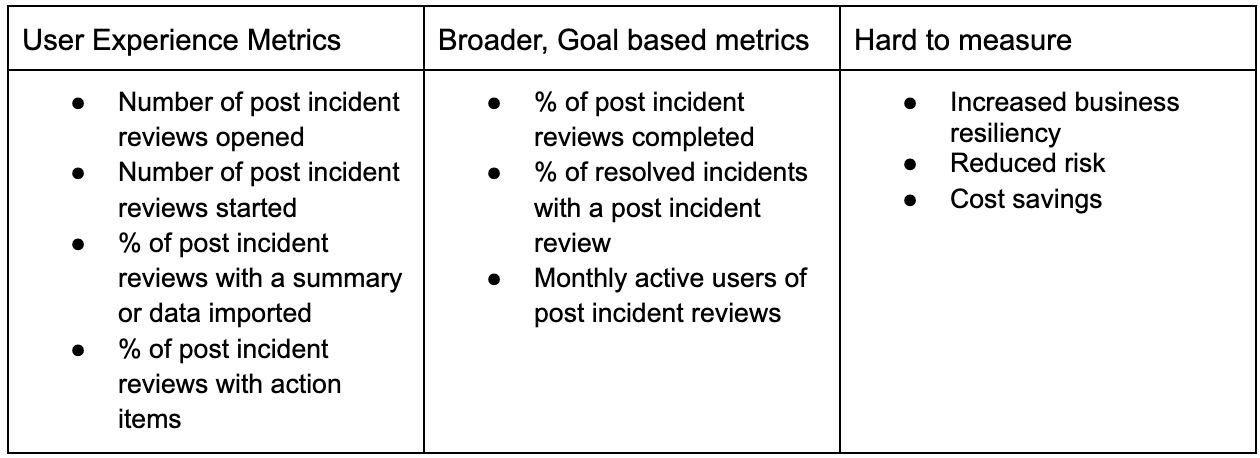
We immediately ruled out User Experience and Hard-to-Measure metrics as our North Star. While valuable for assessing product quality, they don’t directly capture customer impact. Metrics like cost savings or reduced risk, for example, are important outcomes but can only be fully measured by our customers. Our North Star needed to reflect an actionable, leading indicator of success.
After evaluating our options, we chose % of post-incident reviews completed as our North Star Metric. A completed review includes a summary, key learnings, and action items, all of which drive operational improvement. While % of resolved incidents with a post-incident review might indicate adoption, it doesn’t ensure follow-through. Customers who start but don’t complete reviews miss the opportunity to strengthen their operational resilience—a core part of our mission.
Key Takeaways: How to Find Your North Star Metric
1️⃣ Align with your mission – Your NSM should directly reflect customer and business success.
2️⃣ Map the user journey – Identify key touchpoints and metrics at each stage.
3️⃣ Evaluate trade-offs – Choose a metric that’s measurable, actionable, and drives meaningful change.
By applying this framework, any team can define and refine their North Star Metric to stay focused on what matters most.