


Relying on product onboarding is a trap. Your onboarding might be “fine,” it might guide customers through a series of first steps, but if you’re only examining in-product onboarding your viewpoint is too narrow. You’ll miss critical customer problems because you don’t share their perspective. A couple of years ago on PagerDuty’s Growth Team, Drew McKinney (our design leader) and I faced this challenge.
Drew and I caught up to reflect on how we solved that challenge and provide a framework (and Figma template!) for other product teams facing the same problem.
The Problem: Misunderstanding the new customer journey
Looking back a few years, PagerDuty had a significant blind spot: we didn’t fully understand the challenges new customers faced or how they experienced our free trial. Sure we watched the data closely, reported on conversion rates and understood which features new customers used, but there were a lot of unknowns.
For instance, as leaders of the Growth Team, Drew and I knew that during the trial customers received marketing messages and sales outreach, but how many messages? At what cadence? How did customers react to these messages?
At the time we didn’t have a holistic understanding of the new customer experience. Likewise, our sales and marketing partners didn’t have a great view into what we were building in product. We were siloed. As we dug deeper and talked with more customers, we realized that without cross-channel visibility we could be mis-prioritizing our improvements. Worse, some initiatives teams launched might inadvertently worsen the user experience (and hurt conversion!).
What we needed was a way to view the trial experience through our customers’ eyes. We decided to approach this problem as storytellers—building a cohesive narrative about our customers, their challenges, and their path to conversion.
The Approach: Storytelling Through a Journey Map
Every story has key components:
Protagonist: Our customers. Their voice had to drive the narrative. We interviewed over 20 customers and incorporated direct quotes into the storyboard.
Conflict: The challenges customers faced while navigating the trial. When an interview revealed a challenge we dug in, asking open ended questions to tease out the core problems.
Resolution: The paths they could take to successfully convert.
Journey Map FigJam Template
Drew built a FigJam template for our storyboard. This is a living document which we still use to this day. Using FigJam has several advantages, namely the ability to collaborate with other stakeholders, which became very helpful later in the process.
This template is designed to be multi-channel: incorporating our web product, mobile app, marketing communications, and outside sources of information (more on that later).
You can download the template here
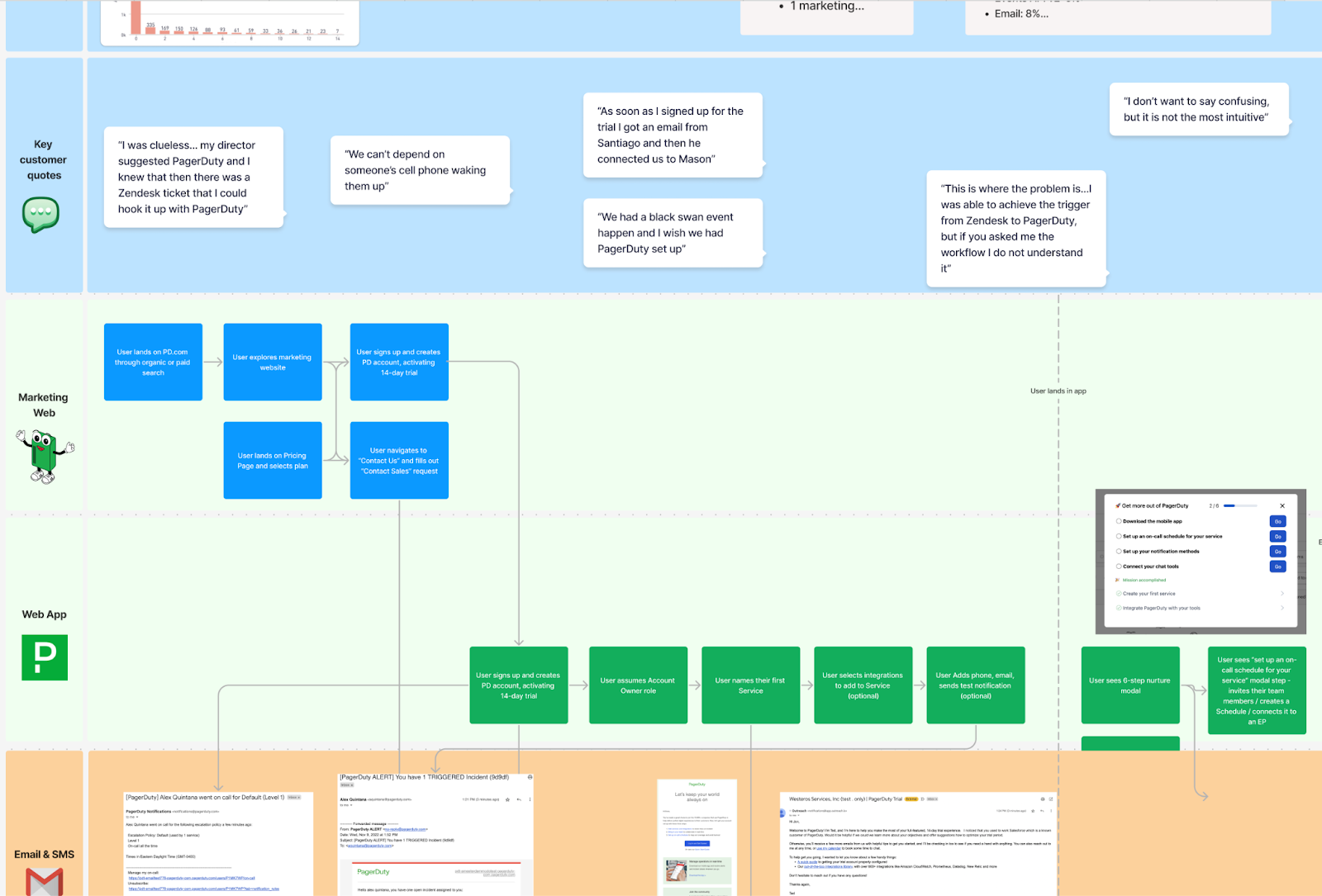
Creating this template was essential and allowed us to quickly put together a full picture of our customer journey. After an initial pass, we invited members of our marketing and customer success teams to fill in gaps that we did not have visibility into. It’s important to note that this was designed to deliberately be “ugly” in order to encourage participation from those who might be wary of disrupting a finished-looking deliverable.
The Data We Gathered
To bring this story to life, we collected a mix of qualitative and quantitative data:
Quantitative behavior data: What were trialists clicking? When were they active? Since our storyboard broke the experience down by day, we took a look at timestamps actions were taken.
Communication Channels: What emails or messages were customers receiving from whom internally? We tracked down screenshots from internal teams and customers. We found that in some cases customers received as many as 5 emails from different PagerDuty orgs (ex: Marketing vs Sales) in a single day.
Screenshots: Visuals of what users encountered
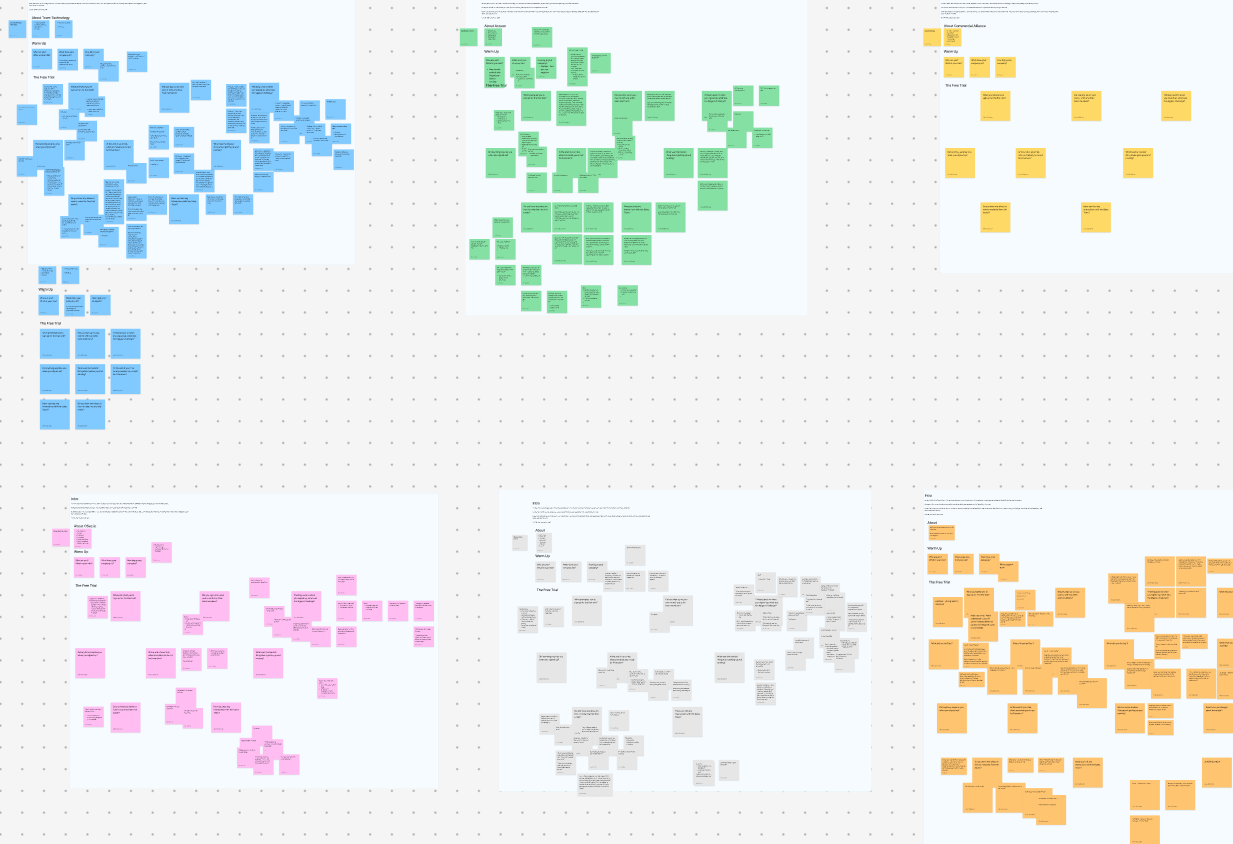
Interviews: We conducted in-depth sessions with over 20 trial users. Working in pairs, we took notes and added them as sticky notes in Figma. We also interviewed our Sales, Marketing, Data and other x-functional partners to understand their perspectives.
Outside sources of information: Likely sources of onboarding information from other places (e.g., YouTube)
We added all of our data to Figma. We met frequently to debrief, come together and tease out themes. For instance, a theme emerged around day 1 backed by both quantitative data (engagement dropped exponentially after day 1) and qualitative data (stories of toil and frustration). We especially looked for themes around challenges. The more we learned the more we were able to tie the themes together into a story.
The Results: Immediate and Long-Term Wins
The finished storyboard became a powerful tool to help stakeholders across PagerDuty understand the experiences of new customers. By creating a fully cross-channel view, we facilitated cross-functional design thinking sessions, walking teams through the storyboard to identify recurring problems and brainstorm targeted solutions.
In several cases, the journey map prompted immediate action. For instance, we discovered that customers received up to five emails from different PagerDuty teams in a single day. Collaborating with a cross-functional team, we consolidated these into a single, clear email, which increased the % of customers who converted within 7 days of opening the email by a whopping 450%.
Beyond these quick wins, the storyboard uncovered key strategic insights. One major finding was the importance of setting up integrations on Day 1. This insight informed subsequent A/B tests, which focused on optimizing the onboarding flow to prioritize integrations. Over time, these changes significantly improved trial completion rates and overall customer satisfaction.
Focusing solely on in-product onboarding is a common pitfall. However, by resisting this temptation and broadening our perspective, we uncovered a richer, more actionable story of the customer journey. Sometimes, the key to driving growth isn’t adding more features—it’s understanding and telling the right story.
Tips for Building Your Own Journey Map
Think Like a Storyteller: Treat your customer’s experience as a story with a beginning, middle, and end.
Collaborate: Pair up for interviews and group findings collaboratively.
Visualize: Use tools like Figma to make the data tangible and shareable.
Act Quickly: Address low-hanging fruit immediately, but don’t lose sight of longer-term opportunities.

Such an interesting resolution to use teams to collaborate and not silo. Reading this after two terrible experiences with software update from Apple and unexplainable problem with PayPal it makes me think there could be a better way to deal with customer frustrations instead of the ubiquitous "Please stay on the phone for a customer survey"